Your students in the last weeks before the break are probably tired, wiggly and a little bit frayed around the edges, right? If you’re looking for one calm moment that brings your class back together, try a classroom gratitude circle.
It takes about five minutes, you don’t need to prepare anything, and every child in your room gets a turn to be heard.
Here’s something I tried myself. For a while I met tired, grumpy kids in the schoolyard in the morning, and I simply asked them about the good things in their lives. You should have seen their faces light up, every single time :-)
A gratitude circle does the same thing, just with your whole class at once.
What is a gratitude circle?
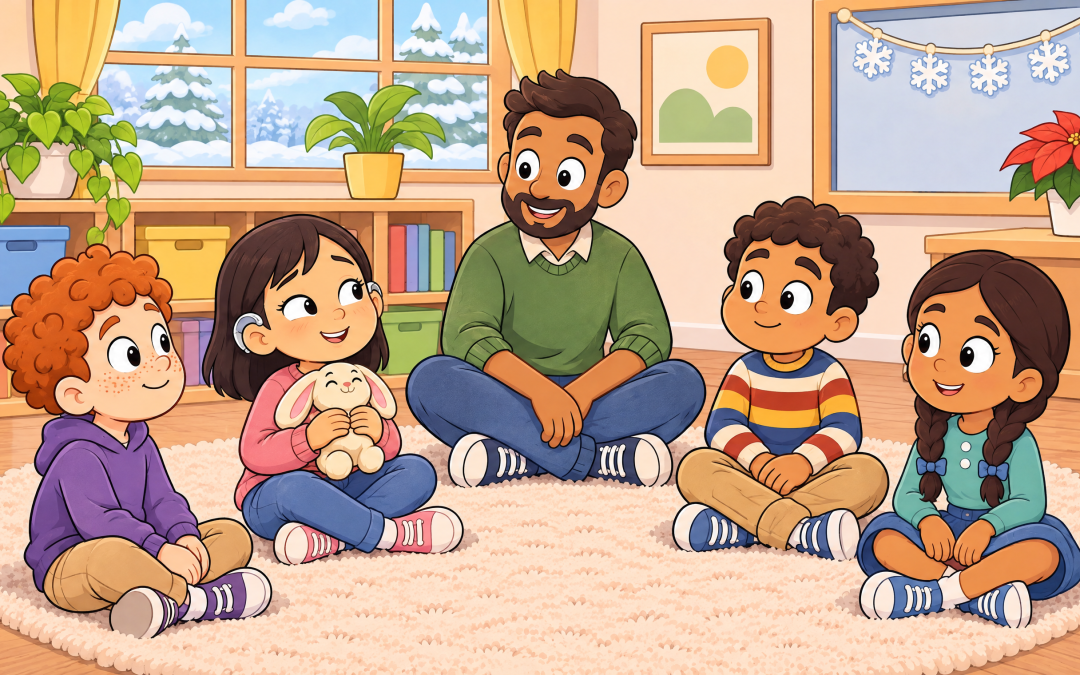
It’s very simple. Everyone sits in a circle, and one by one, each person shares one thing they appreciate. If they like, they can add why it matters to them.
And here’s the most important rule: passing is always allowed.
That’s it! You don’t need worksheets or crafts, and there’s no glitter to vacuum up afterwards.
How to run a classroom gratitude circle in 5 minutes
Purpose: Connection, listening, noticing the good
Best for: Ages 5 to 11, a whole class or a small group
What you need: A soft object to pass, like a small toy or a beanbag
- Sit in a circle. On the rug or on chairs, so everyone can see everyone.
- Pick one prompt. Read it out loud. (You’ll find a list of prompts below.)
- Go first. Answer it yourself in one short sentence, because kids copy what we do far more than what we say.
- Pass the object. Whoever holds it speaks. Everyone else listens. This keeps it to one voice at a time, which also helps any child who finds a noisy room hard to follow.
- One sentence each. A simple “I’m grateful for…” is plenty for most kids.
- Add a gentle “why?” Now and then, ask “Why does that matter to you?” Never push for it. Sometimes “because it’s fun” is the perfect answer.
- Pass is a full answer. A child can say “pass” and hand the object on. Come back to them at the end if they want another try.
- Close with one breath. When the object is back with you, everyone takes one slow breath together. Then on with the day.
With 25 children and one sentence each, you’ll usually be done in about five minutes.
Gratitude prompts for the last weeks of term
You only need one prompt per circle. These come straight from the Blissful Kids gratitude prompt bank.
For younger students:
- Something about our classroom I am grateful for is…
- Something about school I am grateful for is…
- Something about my schoolfriends I am grateful for is…
- Something that I’ve learned I am grateful for is…
- Something someone taught me I am grateful for is…
- A teacher I am grateful for is…
- Something small I am grateful for is…
- Something warm I am grateful for is…
For older students:
- What was the most interesting thing you learned this week?
- So far, what has been the best thing that has happened today?
- What things have made you smile today?
- Who is someone who always pays attention to you when you speak?
You’ll notice that none of these is about presents or holiday plans. That’s on purpose, and the section on safety below explains why.
The 2-minute version for busy days
Some days you don’t even have five minutes, and I get it! Here’s a quicker “popcorn” round you can squeeze in between two lessons.
Purpose: A quick feel-good moment between lessons
Best for: Ages 5 to 11, the whole class
What you need: Nothing!
- Say the prompt: “Something good about today is…”
- Anyone who wants to answer pops up and says it in a few words, then sits down.
- Keep the pace quick and light, like a game of ping-pong.
- Stop after two minutes, or when the ideas naturally run out.
Kids who don’t want to pop up simply stay seated, and nobody is ever called on.
Make it safe for every student
A gratitude circle only works if every child in your class feels safe in it. Here’s what I’d keep in mind:
- Passing is always fine. Some kids need to watch a few circles before they join in. That’s okay.
- Don’t make kids thank each other on demand. Forced praise can turn into a popularity contest, and someone always gets left out. Let any thanks to classmates come on their own.
- Leave room for a hard week. Gratitude doesn’t erase sad, angry or worried feelings. A child can be grateful for one small thing and still have a hard week. Both are true.
- Not every child looks forward to the break. For some kids, holidays mean less routine, less food or a tricky time at home. That’s why the prompts above stay with school, friends and small everyday things.
- Keep it light. If a “thank you” is squeezed out of a child, it rarely feels good. I learned that the hard way at home, and I wrote about it in How NOT to Teach Children Gratitude.
Researchers say the same. Looking at a school gratitude program that worked well with 8 to 11 year olds, two psychologists warned that pushing children to express gratitude could backfire (Layous & Lyubomirsky, 2014). So keep it an invitation, never a test.
Hook it to your timetable
The easiest way to keep a routine going is to tie it to something your class already does every day. Try a little sentence like this:
“After we come in from lunch, we sit in our gratitude circle.”
Or you could do it right before home time on Fridays. Pick one moment and stick to it, and soon the circle becomes “just what we do.”
If you’d like a calm start to the day as well, my morning mindfulness routine for students pairs nicely with it.
Keep it going over the break
Here are two ways to make the good feelings last past the last day of term.
- Make a class gratitude page. Before the break, each child draws or writes one thing from the circle on a shared page or poster. Hang it up for the first day back.
- Try Gratitude Buddies. Pair kids up (with families’ okay) to share one good thing with each other over the holidays. Here’s how Gratitude Buddy works.
Questions teachers ask
How long should a gratitude circle take?
It takes about five minutes for a class of 20 to 25, if everyone shares one sentence. If time is tight, use the 2-minute popcorn version, because short and regular beats long and rare.
What if a student says “nothing”?
That’s okay, and it’s honest :-) Let it count as their answer, or offer a tiny prompt like “something small” or “something warm.” Some kids need a few circles before they find their words.
How often should we do it?
Once a day works well in the last weeks of term, but even once a week is worth it. Pick a regular moment so the kids know when it’s coming. They’ll often start reminding you!
Does a classroom gratitude circle work with 30 kids?
Yes. Keep it to one sentence each and use a talking object so only one person speaks at a time. With a big class you can also split into two circles, or use the popcorn round.
Your turn
Will you try one gratitude circle with your class this week? Just one.
Then come back and leave a comment: what was the best answer your class gave? I’d love to hear it.
Wishing you many grateful moments with your students :-)
With gratitude, Chris Bergstrom
Sources
Layous, K., & Lyubomirsky, S. (2014). Benefits, mechanisms, and new directions for teaching gratitude to children. School Psychology Review, 43(2), 153-159. https://escholarship.org/uc/item/5vr4g18r